Chapter 6: Recruitment and appointment of volunteers/leaders/helpers (leaders) and employed staff
Aim of the chapter
To outline some basic principles for safer recruitment
To describe the recruitment and selection process
To describe management of leaders from other jurisdictions
To describe support and management arrangements
To describe processes for under 18s working with children
To note the appointment of Elders and safeguarding expectations
It is essential to have a recruitment and appointment procedure in place to select leaders in order to provide a safe environment and culture for children and young people in our congregations.
This also gives reassurances to parents and guardians that our mission and ministry is safe, and supports leaders to feel safe in the environment in which they are operating.
Proper appointment procedure is one of the most effective ways of assessing a person’s suitability to work with children and young people, and may act as a deterrent to potential abusers.
We must do all that we can to ensure that anyone who may be unsuitable for working with children or young people is not given the opportunity to become a leader.
It is important that Kirk Session ensures that every potential leader participates in a selection procedure, even if they are already known to the congregation.
This process is to be applied to all volunteers, leaders or helpers regardless of what the local congregation calls the role.
The procedure applies to anyone over the age of 16 working with children and/or young people.
All potential leaders and volunteers must complete the appointment process fully before commencing the role.
New people joining the congregation should not be considered for a leadership role until they have attended the church regularly for at least 12 months.
In the case of someone transferring from another congregation, if evidence can be provided as to commitment, leadership can be considered sooner than this, but not before at least four months worshipping in the new location.
It is recognised that not all leaders in a church are necessarily members of that same church. Some leaders are from the community, or other denominations, and do not attend that local church. Therefore, the first two points cannot apply. In this scenario, Kirk Session remains responsible for the safe recruitment, vetting and supervision of those leaders.
Some Kirk Sessions have decided that all leaders of organisations need to be communicant members first; this remains a decision for individual Kirk Sessions.
This recruitment process applies to all leaders aged 16 and over.
Do not commence anyone in a role until the full process has been completed.
Many congregations are under pressure to cover leadership roles; it is crucial that to sustain leadership in all organisations you have the right people matched to the role. Youth and children’s work is not for everyone and it is critical that the recruitment process is used well to establish skills and values.
The decision to appoint someone into a leadership role should never rest on a clear AccessNI vetting and criminal records check alone; criminal records checks are an essential aspect of recruitment, but they only provide weak evidence of suitability. See Chapter 7.
Defining roles and responsibilities
A role description must be drawn up for each role and given to all leaders. This can be done generically for volunteer leader roles within the organisation.
For paid staff roles, a specific job description and person specification should be created.
One of the most critical safeguarding volunteer roles is the Designated Person. A role description for the Designated Person can be found on the PCI website.
The process
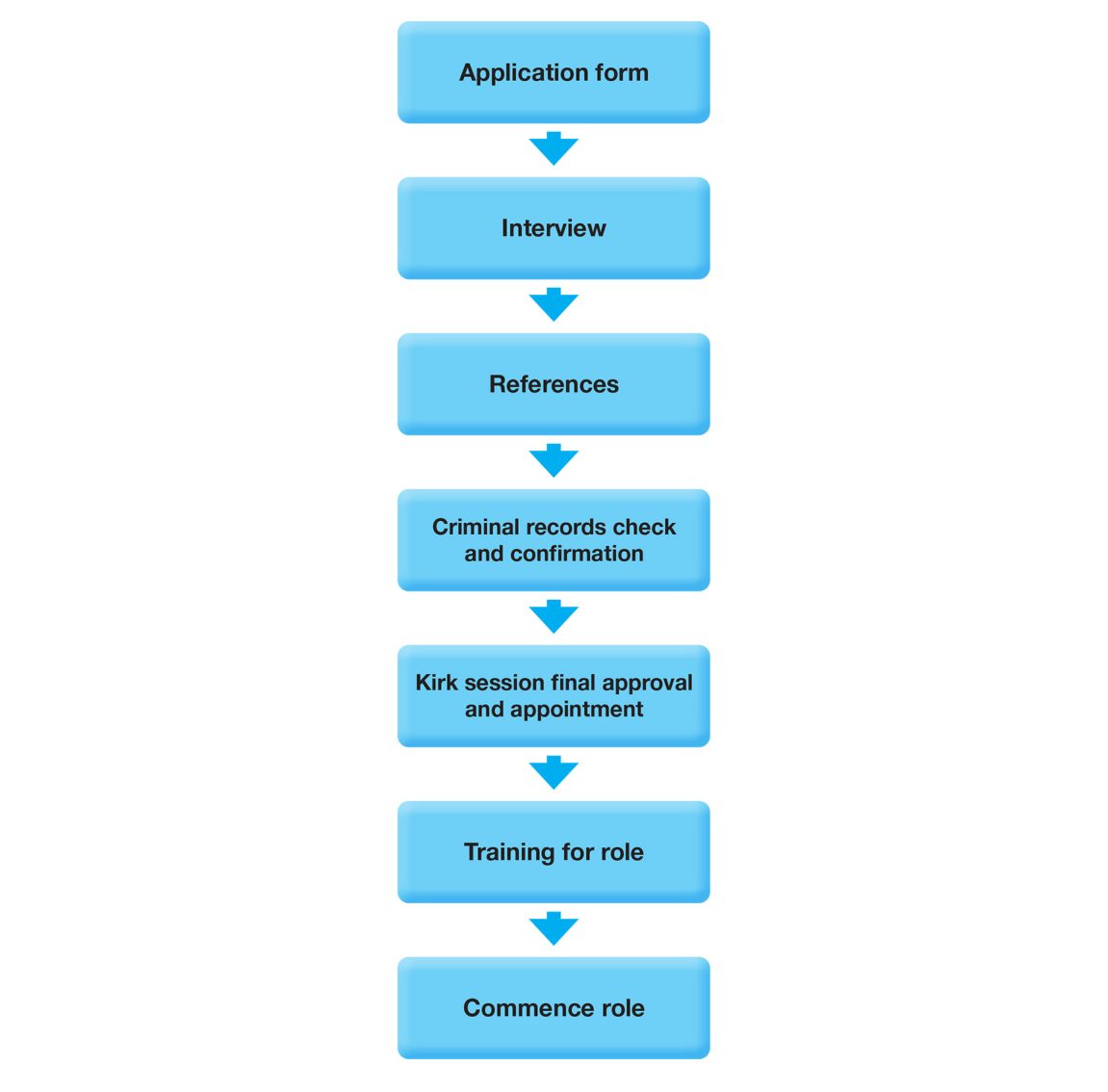
1. Application form and verifying identity
An application form must be completed by everyone applying to work with children and young people. This should cover past employment and volunteering history/experience.
The application form includes the AccessNI vetting process. Applicants are asked to declare any past criminal convictions or police investigations as part of this form. Identity checks for candidates should be carried out with official documentation, e.g. sight of driving licence, passport, proof of address.
All application forms must be signed by either the Minister or a member of Kirk Session to say that as far as they are aware, the applicant is suitable for the role for which they are applying.
Application forms and process are available on the PCI website.
2. Interview
The organisational leader, along with either the Minister, Designated Person or an Elder, should meet the person and ensure that they have the ability and ethos required for the role. This is best established through interview questions.
Example questions can be found on the website here.
At the interview, the safeguarding policy should be provided and explained; this is to ensure agreement and understanding of the basic expectations of safeguarding responsibilities at the earliest stage.
3. Qualifications and professional regulation
You should check the applicant’s qualifications where these are asked for, check if the individual is professionally registered with a regulator (e.g., NISCC) and, if this is part of the requirement of the role, check their professional standing on the relevant register.
4. References
The names of two referees should be given by the applicant.
The referees should NOT be family members, the Minister, Designated Person or either of the interviewers.
If the applicant is coming from a previous place of worship, then a reference should be sought from the previous Minister.
References should be from people who have had first-hand knowledge of the individual’s work with children/young people and have known the applicant for at least two years.
It is usually the role of the Designated Person to send a reference request form to the referees given; references should be taken in writing and followed up orally.
A reference request form is available on the PCI website.
These do not need to be sent to the central PCI Safeguarding Office with the application form but should be kept for the congregation’s own records.
5. AccessNI and Criminal Records Check
All leaders taking up a regulated position to work with children and young people must be vetted.
The process of vetting leaders involves an AccessNI check, which will show if an applicant has any criminal convictions and any other relevant policing information or is listed on any of the UK’s Children and Adults’ Barred Lists held by Disclosure Scotland or the Disclosure and Barring Service (DBS).
A person who does have a criminal conviction will not necessarily be barred from working with children and young people within a church setting. Only convictions considered relevant will be taken into consideration when an appointment is made.
Guidance should, however, be sought from the Safeguarding Office about the nature of any convictions.
Please be assured that all certificates, forms and conviction information are treated sensitively and confidentially by the central PCI Safeguarding Office.
Please refer to the AccessNI Criminal Records Check policy and procedure (see Chapter 7.)
When the full process of application, interview, references and checks are completed, Kirk Session will make a final decision of appointment, and record its agreement of appointment.
Kirk Sessions should make every effort to establish the suitability of candidates by careful use of references and interviews.
You must remain aware that what would be considered an offence in the Republic of Ireland may not be considered an offence in another country, and vice versa.
Any certificates of good conduct should be treated with caution, as there is little way to establish their validity.
Guidance
Always follow the usual recruitment processes as closely as possible
Think about putting additional weight into interview questions
Get checks completed where you can, as per criminal records policy and procedure
Seek references and, when possible, follow up verbally
Verify identity
Ask the volunteer to make a written statement, clearly signing, saying that there is nothing in their background that would disqualify them from volunteering with children and/or young people
It is best practice in safeguarding to ensure that the new leader is clear about how the organisation runs and the expectations of their role.
It is critical that all policy and procedure relevant to the safe running of the organisation is shared prior to commencing the role.
New leaders should have completed all basic training prior to commencing the role.
Trial Period
It is good practice to give all leaders an identified trial period in an organisation, at least 12 weeks.
For paid posts, staff should undertake a six-month probationary period before being confirmed in post.
Supervision
It is good practice for the leader of the organisation to meet at least twice a year with leaders, either individually or as a group. This gives time and space for leaders to discuss concerns, raise training needs and talk about positive experiences and learning with one another.
This practice helps leaders feel valued and allows an organisation’s Leader in Charge to establish if they need any additional training.
Appraisal
All paid staff should have an annual appraisal by their line manager.
Grievances
It is the responsibility of Kirk Session to ensure that all volunteers and leaders are listened to and to have a clear system in place to manage any concerns raised.
Volunteers should be encouraged to speak with leaders at any stage about concerns they face in their role.
Termination of leadership
Most leaders will end their time with an organisation mutually and in a positive manner. When individuals ‘retire’ or move on from a leadership role it is good practice for the organisation to mark the occasion.
This is often a moment of encouragement for the organisation and other leaders to mark faithfulness.
The Leader in Charge of the organisation should advise the Designated Person, who will update their records. It is crucial that a final date of engagement in a role with children and/or young people is recorded. Should the individual return to a role at a later date a new process as above will commence.
If a role needs to be terminated due to concerns about behaviour unbecoming their role or values/ethos issues, this must be managed by the Leader in Charge of the organisation and the Kirk Session.
If the role needs to be terminated due to safeguarding issues or child protection, the Designated Person should also be involved as consideration needs to be made with regard to potential onward reporting.
At all times, the safeguarding reporting procedures take precedence over all other procedures, and safeguarding concerns must be reported as per these procedures. This includes paid and unpaid staff/volunteers.
Records should be kept of any decisions and actions.
Under 18s working with children and young people
16- and 17-year-olds can assist in providing children’s activities.
However, it is never appropriate to require someone aged less than 18 years to take on the role of leader or be in sole charge of children. This would mean, unacceptably, leaving a child in charge of children.
At least two adult leaders should be in charge of any group of children at any time.
16- and 17-year-olds can be counted, in addition to the two adult leaders, in your ratios of children to adults if they have been through the full recruitment process, as above.
Anyone aged 15 and below who is helping with children does not count as part of leadership ratios.
Please note that 16- and 17-year-olds who go through the AccessNI vetting process must have parental/guardian consent for a criminal records check.
16- and 17-year-old leaders should receive the same levels of training as all other leaders in that organisation.
Anyone under the age of 16 who is helping with children should receive an appropriate level of training provided by the leader of the organisation. This should include: appropriate physical contact and language, use of devices while working with children, emergency procedures and First Aid policy.
Such training must also include the need to safeguard themselves in situations where their actions may be misconstrued.