Chapter 3: Responding and reporting and dealing with allegations against leaders
Aim of the chapter
Managing a disclosure of abuse
Other triggers for reporting abuse
Reporting
Mandated reporting and the appointment of a Designated Person
After reporting to Social Services
Responding to allegations against ministers and elders
A flowchart for responding and recording
Managing a disclosure of abuse
Barriers to disclosures from children and young people
It can be very hard for children and young people to open up about what’s happened to them.
They might be worried about the consequences or that nobody will believe them. They might have told someone before and nothing was done to help them. Sometimes they might not know that what’s happening to them is abuse and struggle to share what they’re feeling. Some children don’t reveal they’re being abused for a long time, some never tell anyone. (NSPCC)
Stay calm, express concern and sympathy, reassure and record in the child’s own words.
There are particular barriers for children in faith-based organisations, like our denomination, and we need to be mindful of them.
Often children see that the person harming them is very important. A leader, someone whom the church respects, someone who is in a position of trust and is often at the front of church, and they are afraid they will not be believed.
It may be that children hear the person spoken about often with very positive language, and so they develop an understanding that the person is held in high esteem, and there is a protective fence around those individuals. There is already a power imbalance between children and adults, and this is added to when that adult is in a church-based position of trust and children assess that the individual is very much liked.
It may be that children and young people are left afraid through the ‘spiritually abusive’ grooming activities of an individual. For example, the misuse of biblical language can be terrifying for a child brought up in a church environment. Threats can be made and children can be left feeling shame because of their own sin or evil, or scared of the work of the Devil – a grooming tactic that petrifies a child or young person.
It is the case too that the children and young people of Christian families tend to be more exposed to strangers. Many families extending the beautiful gift of hospitality to strangers who come to our churches and communities tend to have their guard down when inviting individuals into their homes. This generosity of hospitality should not cease, but families need to be aware of managing the risks and keeping their children safe while they reach out to others.
Reasons for disclosing
realising the abuse is wrong
not being able to cope any more
the abuse getting worse
wanting to protect other children
wanting the abuser to be punished
trusting someone enough to tell them
someone asks them directly
their environment has changed and they feel safe
Managing a disclosure
Remember that if a child or young person has chosen you to disclose something to, they have assessed you as being safe and as someone who will help them. This is a privilege to take very seriously.
Follow these simple steps if a child or young person begins to tell you about possible abuse or harm:
Listen carefully
don’t ask them to repeat or ask them leading questions
allow them to tell you anything in their own words
manage your emotions in that moment
Reassure
this is a big moment for them, tell them they’ve done the right thing
tell them you understand them
Be serious
let them know you believe them
let them know you are going to do something about it
do not promise to keep a secret
Safety first
if a child is immediately in harm’s way protect them first using emergency services
advise them in words they understand that this is not their fault, they’ve done nothing wrong
What is next
tell them what you are going to do
tell them who you need to tell
Report and record
write down everything you have been told
report immediately to the appropriate person
do not delay (see below)
It is never your responsibility to investigate the disclosure, nor to judge the truth of the claims or the credibility of the child.
Please note that even if you know that a child or their family is already known to Social Services you must report.
Other triggers for reporting abuse
Harm to children and young people is not always brought to our attention by a disclosure.
We may also become aware because:
someone else tells us
we see injuries that are unusual or do not match the account of how they occurred
we see signs consistent with neglect
an adult admits abuse or harm (common in a ‘confessional’ pastoral space)
a child or young person is alluding to abuse in non-verbal ways (e.g. drawings)
The same principles below apply for any concern of abuse or harm to a child, disclosed or not.
Reporting
Everyone should be alert to the possibility of children that they have contact with may be abused or at risk of being abuse. Acting sensibly but responsibly is a universal duty on all members of the congregation.
Main principles of reporting
Child Protection is a responsibility of everyone within a church setting.
Designated Persons play a key role in reporting to the Trust Gateway Team any concern about the welfare of a child/young person
PSNI 999 in an emergency circumstance where immediate protection is required
You should always inform Social Services if you have reasonable grounds for concern that a child may have been, is being or is at risk of being abused or neglected. (see Chapter 2: Recognising Abuse)
If you are ever unsure if you should report a concern, you should contact Social Services to discuss and take advice
Always keep an accurate written record of what you are reporting in a secure space
Do not delay
We work in an open and transparent manner, it is therefore not appropriate for any leader in PCI to make an anonymous report. All staff members, leaders and volunteers are recruited formally in their roles and should work in an open way. Anonymous reporting makes it difficult for Social Services to examine concerns fully.
Reports to Social Services are made through the Gateway Teams, in person, by telephone or in writing to the duty social work office in the area where the child lives.
Contact details for duty social work offices nationwide are available on the Trust websites.
Designated Person
Each congregation must appoint a Designated Person (DP) who will take a lead in the protection of children and will liaise with outside agencies. Dependent on size, it may be appropriate to appoint one or more Deputy DPs. The DPs will work with the leaders in the reporting of concerns. Internally, they will be a source of advice and support to staff.
Responding to child safeguarding concerns
When a DP is alerted to concerns about a child/young person, their role is to act promptly and in accordance with the Presbyterian Church in Ireland’s reporting procedure, which will include the following steps:
Ensure that the child/young person is in no immediate danger and that any medical or police assistance required has been sought;
Consider whether the concern is a safeguarding issue or not, in line with guidance provided within the policy. This may involve some ‘checking out’ of information but being careful not to stray into the realm of investigation;
Consult with social services where there is any doubt – a hypothetical situation can be explored, and you should be advised on the best course of action to take;
Make a formal referral if Social Services considers the concern to be a safeguarding issue. You should liaise with the Kirk Session representatives in the congregation with whom the statutory requirement to report lies;
Be available, as required, to the investigation undertaken by the statutory authorities;
If it is not considered a safeguarding issue, and it is decided that there should be no referral made to a statutory authority, a record should be made of the concern and the details kept on file, including any action taken, the reasons for not referring, and the situation monitored on an ongoing basis;
The employee or volunteer who raised the concern should be given a clear written explanation of the reasons why the concern is not being reported to Social Services, and the employee or volunteer should be advised that if they remain concerned about the situation, they are free to make a report to Social Services or PSNI.
After reporting to social services
Social services will assess all reports they receive.
They will acknowledge that they have received your report.
To protect the privacy of the child and family it may not be possible to inform you of the progress or outcomes of a report.
You must continue to manage any alleged perpetrator in a precautionary manner until Social Services have completed their processes (see below).
Responding to allegations against ministers, elders, leaders, volunteers
There are duel processes that need to occur to when there are allegations against a leader.
Information, concerns or allegations about leaders can come from a number of different places – in the course of a referral to statutory agencies, to social services or the PSNI and this guidance sets out further steps the organisation need to take in relation to these.
External Reporting
The first priority is always to ensure that no child is exposed to unnecessary risk. The welfare of a child, and reporting of concerns to police and social services, gets precedence in all situations, regardless of who the alleged perpetrator is.
To that end, there is no difference in managing a disclosure or reporting a concern externally if the alleged perpetrator is a Minster or Elder of the Presbyterian Church in Ireland. The process is the same as it would be with any other leader, volunteer, staff member or member of the public.
The detailed provisions of the protocol for the Immediate Mangement of Safeguarding Concerns as they relate to allegations against leaders should be followed. This can be downloaded here.
If a member of the Church feels that their concerns have not been taken seriously by the Church they should follow the Church’s whistle-blowing policy.
Follow all steps as outlined in this chapter for external reporting, without delay.
Internal reporting
Internal reporting is required alongside any external reporting so the immediate risks can be managed across all potential areas of concern.
For example, the issue may have been raised in the context of Sunday School, but the individual of concern might also be a Youth Club leader or engaged in another church.
INTERNAL REPORTING
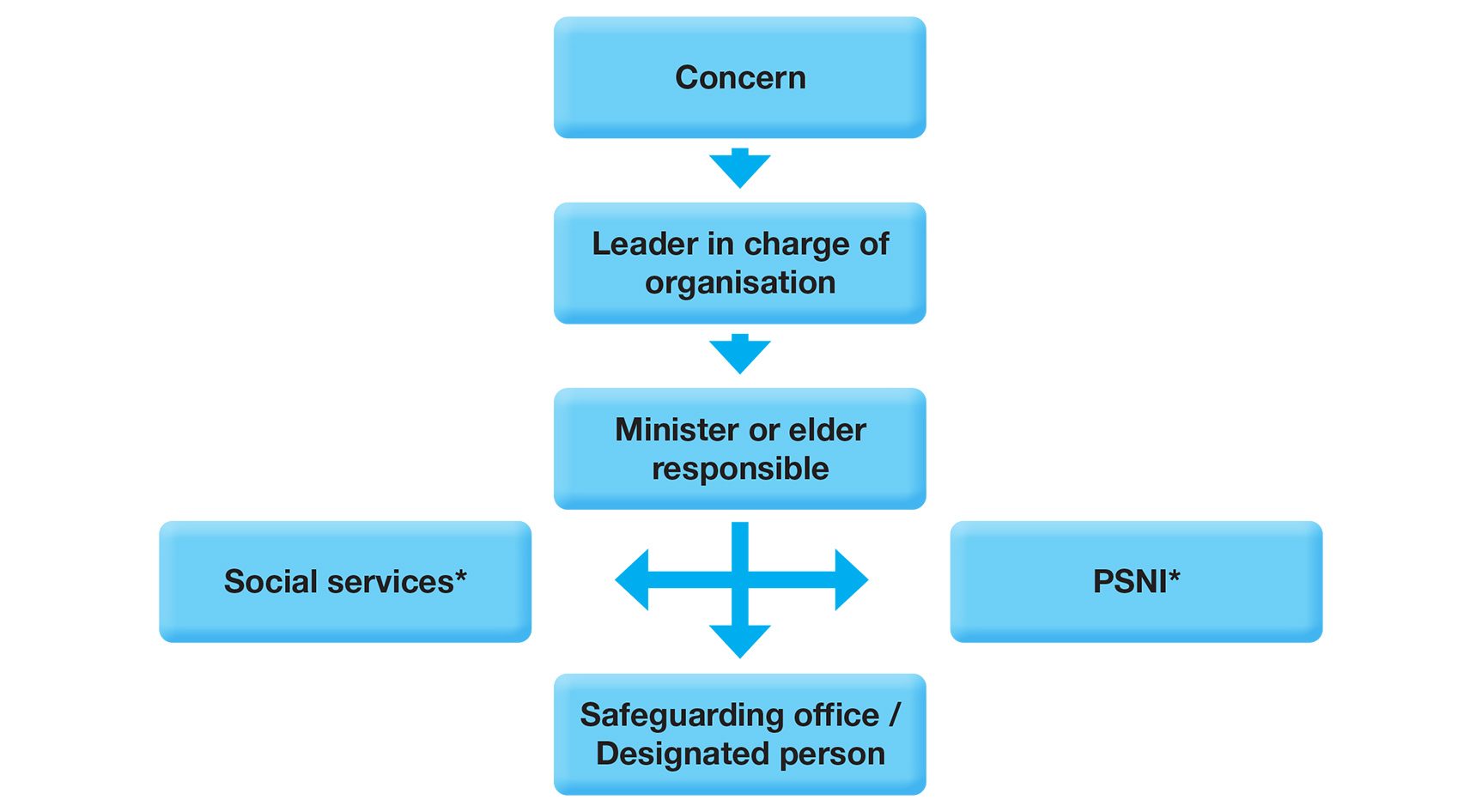
Individual with concern to raise | Leader in charge of the organisation | Minister and Designated Person | Protective measures in place until statutory assessment | Reviewed after statutory outcome
Keeping records
It is very important that good records are kept on safeguarding matters; congregations should use the Report of Concern which can be found here.
Records should be factual and include details of contacts, consultations and any actions taken. It is important that actions taken by the congregation’s safeguarding team are documented.
All agencies dealing with children must cooperate in the sharing of records with social services where a child protection or welfare issue arises. An example of this could be information needed for a Child Protection Conference or Strategy Meeting or information important for the assessment of risk to a child. Ensure that records on child protection concerns, allegations and disclosures are kept securely and safely within the organisation.
Records should only be used for the purpose for which they are intended and should only be shared on a need-to-know basis in the best interests of the child/young person. Child protection and welfare records should be updated as required and reviewed regularly by the Designated Person.
Any individual in an organisation who has reported/needs to report a child protection concern should advise the Leader in Charge of their specific organisation, unless that person is the alleged perpetrator.
The Leader in Charge should advise the Minister (Convenor if vacant) and the Designated Person.
If the alleged perpetrator is the Leader in Charge, the individual should go straight to the minister and/or the DP.
If the allegation was about a DP, this should be made to the minister of the congregation.
If it was about a minister, the report should be made to the DP.
Internal actions
The minister and/or the DP and an elder should, as a matter of urgency, take any necessary protective measures. These measures should be proportionate to the level of risk.
Protective measures taken are precautionary and not disciplinary. Disciplinary action is not the remit of the Safeguarding Team or these procedures.
The protective measures are an interim measure pending the statutory authorities’ consideration of the matter firstly.
Protective measures may include but are not limited to:
Stepping down a leader/volunteer/Elder/Minister from all roles and responsibilities
Removing a leader/volunteer from a specific activity or space
Asking someone to not attend church for a defined period of time
For employed staff, looking at alternative duties that do not involve work with children
If a statutory authority decides that there is no issue for them to follow up on, there will be a further assessment of risk or concerns internally, to support decision-making as to next steps.
Just because there is no ongoing statutory involvement does not mean there are no concerns to manage.
If statutory authorities decide that there is a risk for children and/or young people the church has no authority to override this.
The church must take its lead from the statutory services assessment in this instance and act to fully protect children.
Internal decision-making supports
The minister and Designated Person can take confidential advice from:
PCI Safeguarding Office This is a wide part of its remit and it can advise on what immediate protective steps can be taken and guide through all of the processes. It is normal to advise the safeguarding officers that there has been a child protection issue.
Clerk of Presbytery This individual can advise on Church-led processes and decision-making.
Clerk of the General Assembly In some circumstances, it may be appropriate to escalate to the Office of the Clerk of the General Assembly.
Kirk Session It is critical that confidentiality is maintained, so it is not always appropriate to share sensitive information with the full Kirk Session. Most Sessions now have a small, delegated team to manage the local safeguarding, and that team can be consulted.
Engagement with the alleged perpetrator on the report of allegations of harm
The minster and one elder should privately inform the staff/volunteer/elder:
the fact that an allegation has been made against him or her
the nature of the allegation
if applicable, the fact that the allegation will be brought to/has been brought to the attention of Social Services/PSNI
No details of the victim should be given.
The staff/volunteer/elder should be afforded an opportunity to respond and the response should be noted and passed on if making a formal report to Social Services/PSNI.
At this stage, the staff member/volunteer/Elder against whom an allegation has been made, and his/her family, will require pastoral care, as will any alleged victims and their families.
The individual providing pastoral support to the alleged perpetrator must be different to the individual providing pastoral support to the victim and their family.
In the event that the minister is the individual against whom the allegations are made, all of the above applies; however, these steps will be taken by the Clerk of Presbytery and either the Deputy Clerk or Clerk of the General Assembly.
If any individual has any concerns about a person in a position of trust in the church and feel unable to use the above internal procedure for dealing with an allegation against staff or volunteers, they should in the first instance contact the PCI Safeguarding Office.
Key messages
The safety and well-being of the child must take priority over concerns about the adults against whom allegations may be made
Reports of concerns should be made without delay to Social Services
If you think a child is in immediate danger you should contact PSNI without delay
A flowchart for reporting
* If a child appears to be in danger or at immediate risk, social services and the PSNI should be contacted without delay