Chapter 5:
Responding to, recording and reporting concerns about abuse
Aim of the chapter
- To describe arrangements for responding to concerns of abuse or risk of harm to adults
How staff and volunteers respond to, record and report adult safeguarding concerns
Adults have the right to take risks and PCI recognises the need to provide support to enable them to identify and manage potential and actual risks to themselves.
Where there are concerns raised about an adult at risk, however, or where a disclosure or allegation is made, people often feel anxious about passing on the information. Often there can be delay in passing on vital information.
Leaders who have concerns do not need any evidence of wrongdoing, nor are they responsible for conducting an investigation; they simply need to pass on their concerns through the organisation’s or church’s reporting procedures, as soon as possible.
It is important to remember that it is not the responsibility of one person in our denomination to evaluate information regarding an adult at risk and any safeguarding concerns.
Timely sharing of information is one of the most important ways to prevent and detect adult abuse.
Interrelated principles (as per adult safeguarding HQIA)
There are interrelated principles contained in the national standards for Adult Safeguarding (HQIA) for health and social care providers that are also helpful in offering guidance to the PCI. These include:
- Empowerment – people are empowered to protect themselves from the risk of harm and to direct how they live their lives on a day-to-day basis according to their will and preferences. This requires people having access to the right information in a way they can understand, making decisions about their lives and being supported to engage in shared decision-making about the care and support they receive.
- A rights-based approach – people’s rights should be promoted and protected by health and social care services. These include the right to autonomy, to be treated with dignity and respect, to be treated in an equal and non-discriminatory manner, to make informed choices, the right to privacy and the right to safety. A rights-based approach is grounded in human rights and equality law.
- Proportionality – staff working in health and social care services should take proportionate action, which is the least intrusive response appropriate to the risk presented and takes account of the person’s will and preferences.
- Prevention – it is the responsibility of health and social care services to take action before harm occurs. Preventative action includes care, support and interventions designed to promote the safety, well-being and rights of adults.
- Partnership – effective safeguarding requires working in partnership, that is, health and social care services and the person using the service, their nominated person and professionals and agencies working together to recognise the potential for, and to prevent, harm.
- Accountability – health and social care services are accountable for the care and support they deliver and for safeguarding people using their services. This requires transparency in the ways in which safeguarding concerns are responded to and managed.
Recognise
There are a number of ways in which you may become aware that an adult is at risk:
- They may tell you
- Someone else may tell you
- You may witness something that gives you cause for concern
- You may see signs of physical injury that have no credible explanation
- An individual’s behaviour or demeanour may change or give you cause for concern
- The behaviour of another individual around an adult may be inappropriate
Be aware at all times that there may be a link between adult safeguarding and child protection, i.e. victims and those who harm are part of wider networks and communities including families.
This link should be part of any considerations and where there is a connection, the child protection procedures and mandated reporting must also be followed.
Respond
Confidentiality
When a leader has a concern about an adult, that concern needs to be recorded and reported only to statutory authorities and the ASC in the church.
Leaders and Kirk Sessions must be clear that information relating to a concern, disclosure, allegation or suspicion must only be passed on to the relevant people, whose task it is to decide what action to take.
Do:
- Stay calm
- Listen carefully
- Express concern and acknowledge what has been shared
- Reassure the individual
- Advise the individual what will happen next, of all actions you will take
- Explain the limits of confidentiality (see below)
- Ensure the immediate safety of the person
- If emergency assistance is required (medical/Garda), call emergency services
- If there has potentially been a crime committed be aware that medical forensic evidence may be required – act without delay
Do not:
- Panic
- Ignore; if you are at all unsure about what is occurring, report to those responsible for safeguarding in your church immediately
- Stop someone from disclosing
- Promise to keep secrets
- Press for more details or ask investigatory questions; allow for free recall
- Gossip or discuss with anyone who does not have a legitimate need to know, which includes for the purposes of prayer
- Contact the alleged perpetrator
- Leave details with anyone on voicemail or email
- Delay
Recording
Please see the sample recording form: Add Link here
- Make a written report of what you have heard or witnessed
- Note any action taken
- If a disclosure was made, at all times use the individual’s own words, do not paraphrase
- Sign and date your record
- Give your record to the Adult Safeguarding Champion (or Designated Liaison Person if they oversee all safeguarding) or Mandated Person (Minister in ROI) in your congregation
- Do all of this within 24 hours of the concern
Report
As a denomination we have a responsibility, without delay, to involve statutory services, even if it does not involve church personnel directly, when we are concerned about the safety of an adult at risk.
Ensure at all times that you are keeping the adult raising the concern informed. Be clear about who will be made aware of the information.
You must not delay; therefore, it is not always appropriate to wait to speak with someone from the central PCI Safeguarding Team, which is only operational during office hours on Monday to Friday. The team is there to support the denomination with all safeguarding situations; however, you must not delay in involving statutory services if there is an immediate risk.
Reporting adult safeguarding concerns to the appropriate authorities
As per recording procedures, there must be no delay in reporting to statutory authorities any concerns about an adult in need of protection.
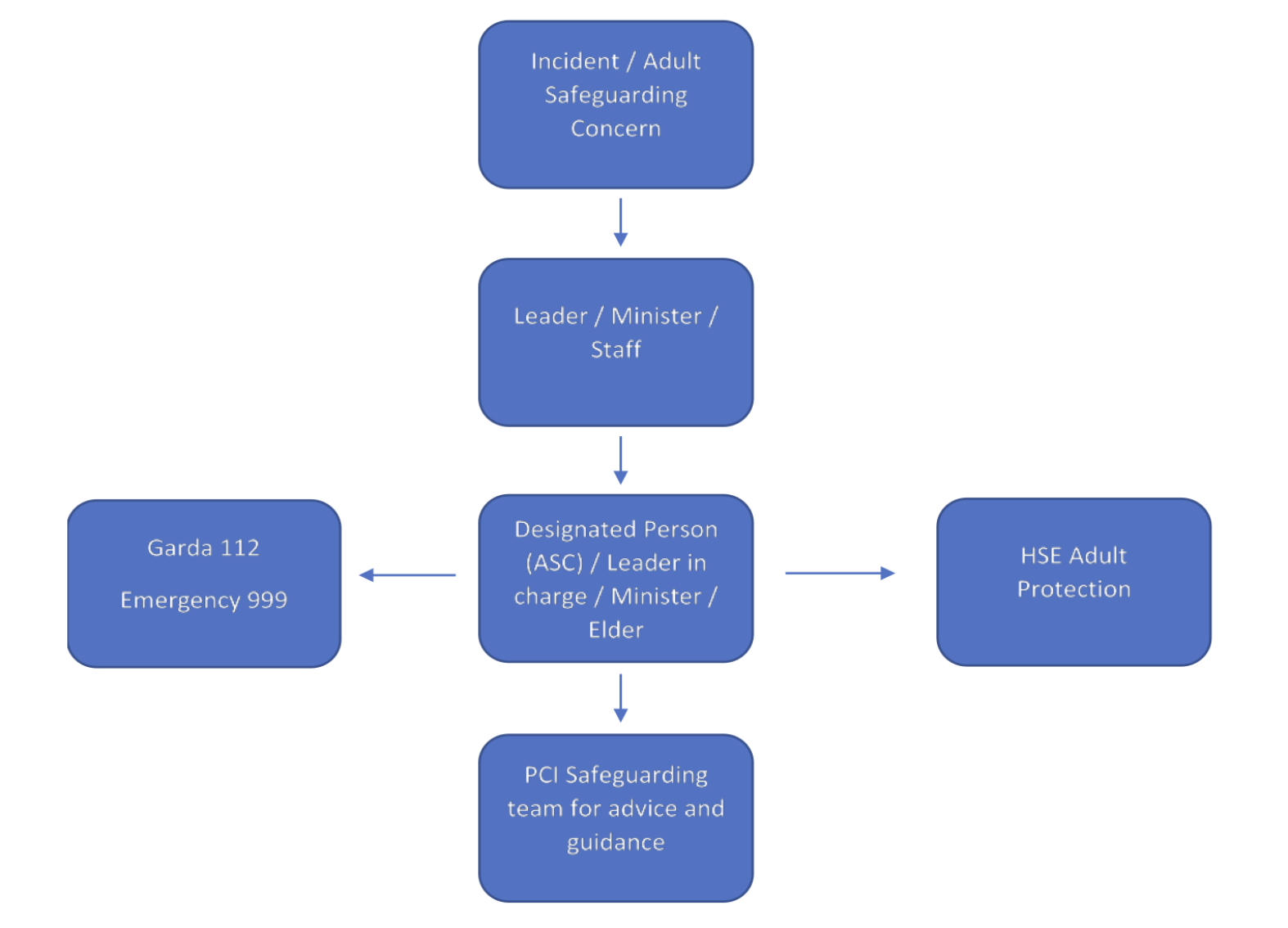
When a concern is raised about an adult at risk or in need of protection, the ASC (Designated Safeguarding Person) must:
- Where immediate danger exists or the situation warrants immediate action, ensure that any medical assistance has been sought and refer to the HSE and/or Garda
- Ensure that any actions take account of the adult’s wishes
- When practicable contact the Safeguarding Lead or Safeguarding Office at PCI for advice and support (do not let this be a source of delay – the Safeguarding Office operates Monday to Friday 9.30am to 4.30pm only and is not an emergency response service)
- Where it has been deemed that it is not a safeguarding issue, alternative responses must be considered such as monitoring, support or advice to leaders or Kirk Session, signposting to external agencies for specific support
- A record must be made of the concern and the details kept on file, including any action taken or the reasons for not referring
- If it is decided that it is a safeguarding issue, a referral will be made to the HSE. The HSE will then conduct a risk assessment and decide what response is appropriate
- If a crime is suspected or alleged, contact Garda without delay
- Act as the liaison point for any investigative activity which is required and will ensure easy access to relevant case records or leaders/Kirk Session
- Ensure accurate and timely records and any adult safeguarding forms required have been completed
Where there is any doubt or uncertainty about whether there is a safeguarding issue this must be discussed with the HSE.
Please find the relevant contact details for statutory partners here: Add link here
All congregational ASCs must hold the relevant HSE and local Garda contact details: Add link here
Each church will fall within one of the local council areas.
Flow chart for reporting