Last month, on a visit to Poland, Presbyterian Moderator, Right Reverend Dr Richard Murray, visited a place that has become synonymous with mans’ inhumanity to man – Auschwitz. Today, On the 80th anniversary of its liberation, the day set aside as International Holocaust Memorial Day, he reflects on that visit, saying that ‘it's sobering to remember that the evil which took place there actually happened within living memory.’
News
The Holocaust 80 years on
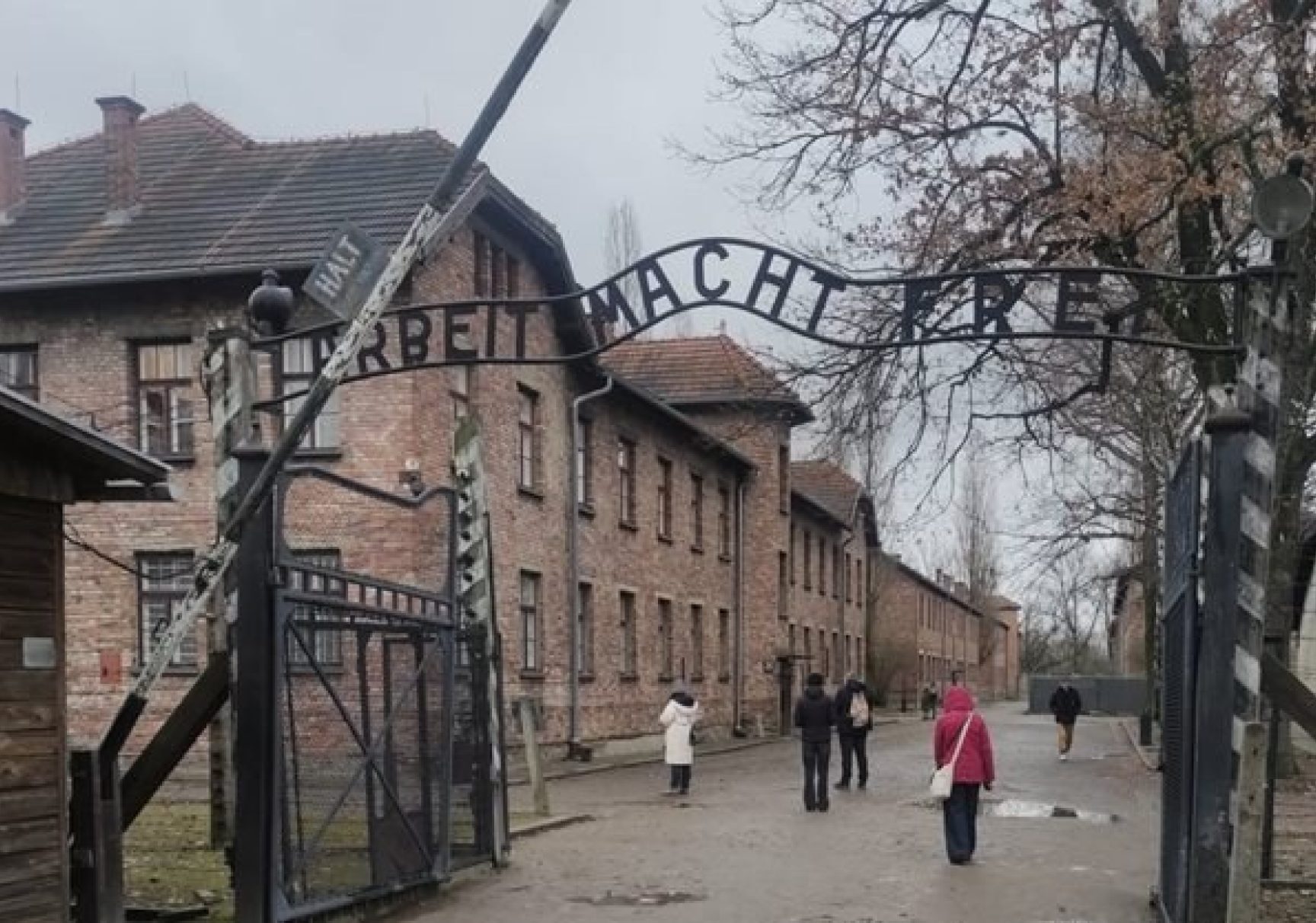
“Today, on Holocaust Memorial Day, people of faith and none, will remember an unequalled tragedy in history that saw six million Jewish men, women and children, and the millions of other victims of the Holocaust, who were murdered by the Nazi’s and their collaborators. Such evil can only forever be a stain on humanity and the world,” Dr Murray said.
“In commemorating those who perished, the lives and the human potential that was lost with them, we also lament what happened, and try and ensure that it never happens again.”
Last month Dr Murray visited a fledgling Presbyterian denomination in Poland, preaching in a congregation in Kraków. During his time there he travelled to Auschwitz-Birkenau, the largest of the Nazi death camps.
“Even before I visited, it was sobering to remember that the evil which took place there actually happened within living memory. When we arrived, our guide told us, ‘You are not visiting a tourist attraction today, it is a mass grave you’ve come to’. Dr Murray said.
“As we were guided around Auschwitz, and the massive adjacent camp at Birkenau, the next four hours were harrowing and unforgettable. The gas chambers we stood in, the electric fences, rows of barracks, the crematoria, and the gallows that we saw, all instruments of systematic murder and unspeakable evil. You just came away stunned and numb.”
Returning home that evening, Dr Murray read a book in the airport that he had bought earlier that day. In ‘Night’, (which Dr Murray had read before) Ellie Wiesel wrote about having been deported from Hungary to Auschwitz in 1944 as a teenager.
“Reading it again, having stood in one of the barracks that morning, the words on the page were even starker. In a famous passage, he wrote, ‘Never shall I forget that night, the first night in the camp, that turned my life into one long night seven times sealed. Never shall I forget that smoke. Never shall I forget the small faces of the children whose bodies I saw transformed into smoke under a silent sky… Never shall I forget those things, even were I condemned to live as long as God himself. Never.’ Such powerful writing of an unimaginable horror.”
Dr Murray continued, “When world leaders gather later on today in Auschwitz-Birkenau, to commemorate its liberation 80 years ago, they will not be able feel the sheer hopelessness of the place, experienced personally by the dwindling number of survivors who will join them, and were there eight decades ago. They are a living memorial to what took place, and testament to what could happen again.”
On Thursday of last week, the Moderator attended the Northern Ireland ceremony to mark Holocaust Memorial Day, which took place in Belfast City Hall. The event not only marked the 80 years since the liberation of Auschwitz-Birkenau, but the 30th anniversary of the genocide in Bosnia.
The Moderator concluded by saying, “So what might our response be, except to love our neighbour, as our Lord Jesus commands? We must continue to remember and commemorate, continue to tell of the Holocaust’s horrors to each new generation.
“We also need to lament what happened and mourn that it has already happened again, admittedly on a smaller scale, in Bosnia, Rwanda, Cambodia, and Darfur, and in many other places since – and resolve to search our own hearts for anything ugly that treats people as less than a person made in the image of God.”