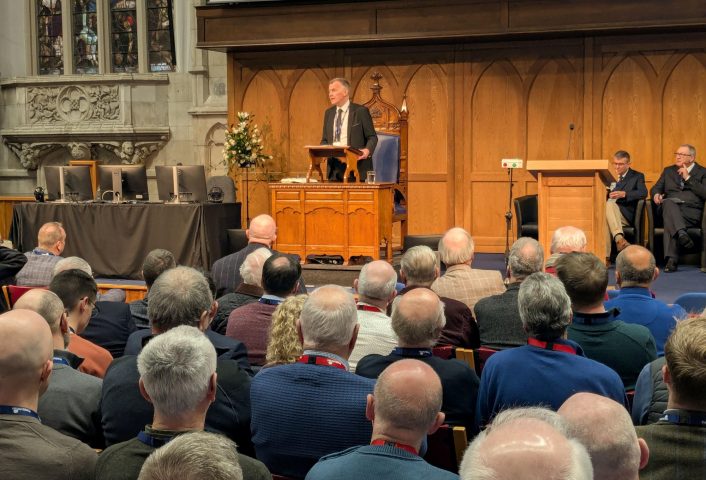
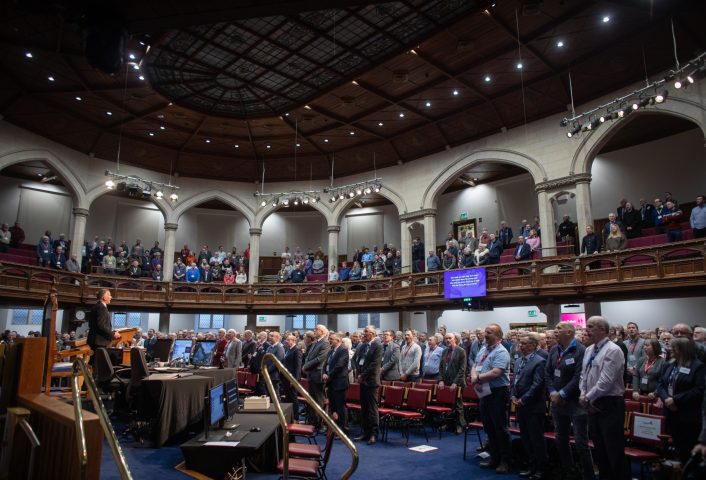
The Presbyterian Church in Ireland (PCI), meeting in Special Assembly in Belfast today agreed to establish a task group ‘to inquire into issues of governance, culture and integrity’ within the all-Ireland denomination, with the aim of improving the proper functioning of the Church.
In the section of the Report of the General Council, which Members of Assembly debated, it said that, ‘while some issues reported through the PCI and PSNI Helplines and other avenues will be safeguarding and PSNI related, some will not. These will relate to issues of governance, culture and integrity at a denominational level. These areas should be examined by the Church.’
Having spoken on this particular point, the Convener of the General Council, Very Rev Dr David Bruce, said that others had raised issues suggesting,
“that our processes are closed, remote, and lacking transparency. Others have been critical of how we deal with disagreements or disputes. Sadly, some have told us of failures in leadership, including moral failures or conduct which calls into question the integrity of leaders, leaving them open to the charge of hypocrisy, or worse.
“To be clear, any disclosures made through the response line or directly to the General Secretary’s office alleging misconduct, will be investigated in the appropriate way. If there is a safeguarding dimension to the disclosure, the Safeguarding Team will respond by referrals to the Police and Social Services. If there is a question regarding a leader’s moral behaviour, this too will be investigated. Sanctions open to Presbytery are already provided for in the Code, and the General Assembly Advisory Committee can appoint assessors to assist Presbyteries in this sensitive work.”
With regards to safeguarding concerns around a minister or elder, or a person in senior leadership within the denomination, Dr Bruce said that there was a protocol to follow that had been agreed by the General Council.
“This allows for the precautionary suspension of a leader from their duties, without prejudice, and pending the outcome of any enquiry into the matter. In some cases, such an enquiry will be by the Presbytery alone. In other cases where required, it may involve statutory authorities, in which case their work takes precedence. In all cases involving ordained leaders, the relevant Presbytery is involved through their Clerk, in both the decision-making and implementation stages.”
Due to the situation that PCI finds itself Currently, Dr Bruce said that some commentators have asked if the existing governance arrangements of Commissions, Councils and Committees of the Church were fit for purpose. He said that the Charity Commission for Northern Ireland’s independent external review panel “will have this question before them from the start, since the Charity Commission quite rightly needs to be satisfied that we can manage the work of the charity competently.
“But alongside this, is our own understanding of the Presbyterian form of Church Government to which we are committed, and in addition, the ongoing work of a Structures and Resources Review, which has been meeting for the past 18 months. To this end, the General Council proposes the formation of a Task Group to examine the issues of Governance, Culture and Integrity, aiming to improve the proper functioning of our Presbyterian form of Church government going forward…”
After debate, and the passing of a number of amendments to the resolution, the Special General Assembly agreed to establish a Task Group of the General Council to ‘inquire into issues of governance, culture and integrity within the Presbyterian Church in Ireland with the ail of improving the proper functioning of our Presbyterian form of Church government according to principles regarding the same to be provided by the Doctrine Committee.’
With regards to safeguarding concerns around a minister, elder, or a person in senior leadership within the denomination, that Dr Bruce spoke of, a separate resolution agreed earlier stated that ‘the protocol for standing down ministers, elders and senior leaders be circulated to all ministers and Kirk Sessions and be reviewed in light of any feedback at the next meeting of the General Council.’ It also stated that the protocol would then be brought to the 2026 General Assembly for its approval, ‘or other date as called by the Moderator.’
In a separate development, the General Assembly agreed to establish a Task Group of the General Council to consider ‘all aspects of the use of compromise agreements.’ This would include the use of Non-Disclosure Agreements, known as NDAs. The General Council was instructed to report to the General Assembly in June of next year.
Proposing the resolution that established the review, Dr Bruce said,
“There has been considerable publicity surrounding the occasional use by the church of Compromise Agreements on the ending of employment, especially where these arrangements involve some elements of confidential or Non-Disclosure Agreements between the parties at the time.
“The General Council recognises the need for a careful examination of this question in principle, from a theological, moral and practical perspective, and possibly also a legal perspective, should proposed changes to legislation by the UK government be passed and enacted in Northern Ireland.
“The Council also recognises that there is a time for confidentiality, just as there is a moral value in transparency…The question as to whether it is ever the right thing to do to invoke such clauses needs to be carefully examined before we as an Assembly finally determine a policy on the matter. It is this space for thoughtful reflection which is needed.